---
title: Aegina
author: Joshua J. Mark
source: https://www.worldhistory.org/Aegina/
format: machine-readable-alternate
license: Creative Commons Attribution-NonCommercial-ShareAlike (https://creativecommons.org/licenses/by-nc-sa/4.0/)
updated: 1970-01-01
---
# Aegina
_Authored by [Joshua J. Mark](https://www.worldhistory.org/user/JPryst/)_
Aegina is an island in the Saronic Gulf, south of [Athens](https://www.worldhistory.org/Athens/). It was one of [Greece](https://www.worldhistory.org/greece/)'s early maritime powers, famous for minting the earliest coins in Greece which were accepted all over the [Mediterranean](https://www.worldhistory.org/disambiguation/mediterranean/) region. According to the classical writer [Ovid](https://www.worldhistory.org/ovid/) (43 BCE - 17 CE), the island was originally known as [Oenone](https://www.worldhistory.org/Oenone/). As the myth explains, the [god](https://www.worldhistory.org/God/) [Zeus](https://www.worldhistory.org/zeus/), in the shape of a great flame, carried off the [nymph](https://www.worldhistory.org/nymph/) Aegina and kept her on the island. In time, she gave birth to a son, Aeacus, who renamed the island after his mother.
### A Prosperous [City](https://www.worldhistory.org/city/)
According to [Herodotus](https://www.worldhistory.org/herodotus/), Aegina was a colony of the city of [Epidaurus](https://www.worldhistory.org/epidaurus/), a prosperous cult center for the demigod [Asclepius](https://www.worldhistory.org/Asclepius/), located on the coast of the [Peloponnese](https://www.worldhistory.org/Peloponnese/). This city was an important Mycenaen stronghold, and artifacts discovered on Aegina have established that the Mycenaen [culture](https://www.worldhistory.org/disambiguation/culture/) survived on the island long after the Doric Invasion of c. 1200 BCE which supplanted it.
The wealth of Epidaurus seems to have been put to good use by the citizens of Aegina in that the island flourished early on and, in time, came to rival Athens. The standard of weights and measures developed by Aegina became the standard all over Greece, they were the first to mint coins, and their fleet of ships carried on [trade](https://www.worldhistory.org/disambiguation/trade/) throughout the Mediterranean and the [Aegean](https://www.worldhistory.org/aegean/) all the way to [Egypt](https://www.worldhistory.org/egypt/) and the Persian [Levant](https://www.worldhistory.org/levant/). While Herodotus (c. 484 – 425/413 BCE) claims that Athens and Aegina became enemies over a feud involving statues of two deities, it is more likely that the mainland city grew envious of the island city's prosperity and, further, concerned over their trade with [Persia](https://www.worldhistory.org/Persia/).
### Foreign Affairs
The Ionian [Greek](https://www.worldhistory.org/disambiguation/greek/) colonies in [Asia Minor](https://www.worldhistory.org/Asia_Minor/), under Persian control, had been a source of conflict for the [Persian Empire](https://www.worldhistory.org/disambiguation/Persian_Empire/) for years. After the Ionian Revolt of 499-493 BCE, in which the Greek colonies were defeated by the Persian forces and order restored, Aegina, which had not been involved in the conflict, sent Persia symbols of submission which amounted to a pact in the eyes of Athens. The Athenians had supported the Ionian Revolt (along with the city of Eretria) as far as supplying troops and arms to the colonies. Aegina's gesture of goodwill toward Athens' enemy would not have been taken well. In retaliation for Greek support of the Ionian Revolt, [Darius I](https://www.worldhistory.org/Darius_I/) of Persia (c. 550-486 BCE) invaded Greece in 490 BCE but was beaten back at The [Battle](https://www.worldhistory.org/disambiguation/battle/) of [Marathon](https://www.worldhistory.org/marathon/).
[ 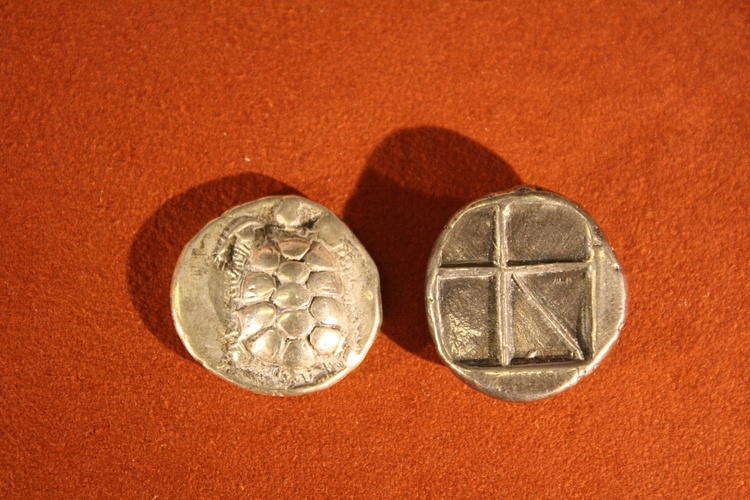 Silver Stater of Aegina Mark Cartwright (CC BY-NC-SA) ](https://www.worldhistory.org/image/818/silver-stater-of-aegina/ "Silver Stater of Aegina")Ten years later, [Darius](https://www.worldhistory.org/disambiguation/darius/)' son, [Xerxes I](https://www.worldhistory.org/Xerxes_I/) (r. 486-465 BCE), invaded Greece to complete what his father had begun. After a series of battles (including the famous [Battle of Thermopylae](https://www.worldhistory.org/thermopylae/)), he was defeated at the [Battle of Salamis](https://www.worldhistory.org/Battle_of_Salamis/) in 480 BCE by the combined naval forces of Athens and Aegina. As there is no evidence of warm relations between Athens and Aegina, nor any evidence of a breakdown in relations between Aegina and Persia between the pact in 491 BCE and the Battle of [Salamis](https://www.worldhistory.org/disambiguation/Salamis/), it would seem as though Aegina was forced to fight against the Persians in the patriotic aftermath of [Thermopylae](https://www.worldhistory.org/thermopylae/). Whatever their motivation was, Aegina's ships played a crucial role in the destruction of the Persian fleet. Following this, however, Aegina fell under the shadow of Athenian naval and commercial supremacy and began to decline.
### Decline
Aegina fought against Athens in the First [Peloponnesian War](https://www.worldhistory.org/Peloponnesian_War/) (460-445 BCE) where they were probably backed by the Persians who not only protected their trade interests but also supported the enemy of their enemy (Athens). With or without Persian support, however, Aegina's time of greatness was over. By the time [Plato](https://www.worldhistory.org/plato/) wrote his dialogue of the *Phaedo* (c.380-360 BCE) Aegina was considered little more than a pleasure resort. In the dialogue, when Echecrates asks Phaedo, "But Aristippus and Cleombrotus, were they present?" Phaedo answers, "No, they were not. They were said to be in Aegina." Aristippus was the founder of the Cyrenaic school of [philosophy](https://www.worldhistory.org/philosophy/), which taught that pleasure is the only intrinsic good, and an informed ancient reader of Plato's dialogue would have understood these lines as a kind of `inside joke' equating the Cyrenaic's hedonism with the island of Aegina.
#### Editorial Review
This human-authored definition has been reviewed by our editorial team before publication to ensure accuracy, reliability and adherence to academic standards in accordance with our [editorial policy](https://www.worldhistory.org/static/editorial-policy/).
## Bibliography
- [Durant, W. *The Life of Greece.* Simon & Schuster, 2011.](https://www.worldhistory.org/books/B004ZZS4YA/)
- [Herodotus. *The Histories by Herodotus.* null, 2006.](https://www.worldhistory.org/books/B002KT3TA2/)
- [Ovid. *The Metamorphoses of Ovid.* Mariner Books, 1995.](https://www.worldhistory.org/books/0156001268/)
- [Plato. *THE COMPLETE WORKS.* The Complete Works Collection, 2011.](https://www.worldhistory.org/books/B0053DLB34/)
- [Thucydides. *The History of the Peloponnesian War.* Penguin Classics, 1972.](https://www.worldhistory.org/books/0140440399/)
## About the Author
Joshua J. Mark is World History Encyclopedia's co-founder and Content Director. He was previously a professor at Marist College (NY) where he taught history, philosophy, literature, and writing. He has traveled extensively and lived in Greece and Germany.
- [Linkedin Profile](https://www.linkedin.com/pub/joshua-j-mark/38/614/339)
## Timeline
- **c. 3000 BCE**: [Aegina](https://www.worldhistory.org/Aegina/) inhabited during [Neolithic period](https://www.worldhistory.org/Neolithic/).
- **c. 700 BCE**: Coins first minted on the island of [Aegina](https://www.worldhistory.org/Aegina/).
- **c. 570 BCE**: First [Temple](https://www.worldhistory.org/temple/) of Aphaia complex built on [Aegina](https://www.worldhistory.org/Aegina/).
- **510 BCE**: Fire Destroys the [Temple](https://www.worldhistory.org/temple/) of Aphaia complex and other structures.
- **c. 501 BCE**: [Aegina](https://www.worldhistory.org/Aegina/)'s [culture](https://www.worldhistory.org/disambiguation/culture/) is at its height.
- **c. 490 BCE - c. 480 BCE**: Supremacy of [Aegina](https://www.worldhistory.org/Aegina/)'s naval fleet. [Temple](https://www.worldhistory.org/temple/) of Aphaia rebuilt.
- **480 BCE**: [Aegina](https://www.worldhistory.org/Aegina/)'s fleet participates significantly in the [Battle of Salamis](https://www.worldhistory.org/Battle_of_Salamis/). Aegina awarded the victory wreath.
- **459 BCE - c. 456 BCE**: [Athens](https://www.worldhistory.org/Athens/) conquers [Aegina](https://www.worldhistory.org/Aegina/). Island becomes subject/ally of Athens. Begins to decline.
## External Links
- [The Princeton Encyclopedia of Classical Sites, AIGINA Greece.](http://www.perseus.tufts.edu/hopper/text?doc=Perseus:text:1999.04.0006:entry=aigina)
- [Aegina](https://universalium.academic.ru/69086/Aegina)
- [Aeginetan Naiad Nymph of Greek Mythology](https://www.theoi.com/Nymphe/NympheAigina.html)
## Cite This Work
### APA
Mark, J. J. (2011, April 28). Aegina. *World History Encyclopedia*.
### Chicago
Mark, Joshua J.. "Aegina." *World History Encyclopedia*, April 28, 2011. .
### MLA
Mark, Joshua J.. "Aegina." *World History Encyclopedia*, 28 Apr 2011, .
## License & Copyright
Submitted by [Joshua J. Mark](https://www.worldhistory.org/user/JPryst/ "User Page: Joshua J. Mark"), published on 28 April 2011. The copyright holder has published this content under the following license: [Creative Commons Attribution-NonCommercial-ShareAlike](https://creativecommons.org/licenses/by-nc-sa/4.0/deed.en). This license lets others remix, tweak, and build upon this content non-commercially, as long as they credit the author and license their new creations under the identical terms. When republishing on the web a hyperlink back to the original content source URL must be included. Please note that content linked from this page may have different licensing terms.