---
title: Acquarossa
author: Mark Cartwright
source: https://www.worldhistory.org/Acquarossa/
format: machine-readable-alternate
license: Creative Commons Attribution-NonCommercial-ShareAlike (https://creativecommons.org/licenses/by-nc-sa/4.0/)
updated: 2024-11-29
---
# Acquarossa
_Authored by [Mark Cartwright](https://www.worldhistory.org/user/markzcartwright/)_
Acquarossa, located in the north of [Italy](https://www.worldhistory.org/italy/)'s Lazio region, is the site of an [Etruscan](https://www.worldhistory.org/Etruscan_Civilization/) settlement of unknown name. Although much smaller than other, more famous Etruscan towns, Acquarossa has proved invaluable for archaeologists as it has not been built over since Etruscan times. Excavations have revealed early public and private buildings along with many examples of the distinctive terracotta roof decorations so typical of [Etruscan architecture](https://www.worldhistory.org/Etruscan_Architecture/). Acquarossa was mysteriously destroyed and abandoned c. 500 BCE, perhaps at the hands of a rival [city](https://www.worldhistory.org/city/) at a time when the larger Etruscan towns struggled to meet the demands of their growing urban population and so annexed the lands of their smaller neighbours.
### [Architecture](https://www.worldhistory.org/disambiguation/architecture/)
Acquarossa was built on a plateau 6 km north of Viterbo at the northern edge of the Lazio region in central Italy. The town was under the jurisdiction of [Cerveteri](https://www.worldhistory.org/Cerveteri/) (aka Cisra/Caera). Excavations were carried out at the site by Swedish archaeologists between 1966 and 1978 CE, which revealed an [Iron Age](https://www.worldhistory.org/disambiguation/Iron_Age/) village with traces of circular and oval huts. These are from the [Villanovan culture](https://www.worldhistory.org/Villanovan_Culture/), precursor to the [Etruscans](https://www.worldhistory.org/Etruscan_Civilization/). Later 7th-century BCE foundations of Etruscan rectangular houses were made from tufa blocks. Walls would have been constructed using sun-dried mud bricks faced with plaster or, more rarely, tufa blocks set between wooden support posts. Thatch roofs were decorated with terracotta additions nailed to the ends of the wood beams and a central hole which allowed smoke to escape was covered with a movable tile of the same material.
Excavations revealed traces of a large complex which included a [temple](https://www.worldhistory.org/temple/) dating to the second quarter of the 6th century BCE. Two buildings here were built on an L-shaped plan with porticos of wooden columns set on stone bases and with capitals. One room has stone benches along three of the walls. A long trench contained the remains of sacrifices, pointing to a cult practice at the site.
Acquarossa had a population of around 7,000 at its peak, and 40 houses have so far been excavated. Although there is a single well-defined street and stone channels were cut to aid drainage and fill cisterns, there is little evidence of town planning. Larger housing from the 6th century BCE is composed of multiple intercommunicating rooms. Some houses had a porch entrance and an adjacent space cut from rock, dedicated for the housing of animals. Several houses are grouped together around a shared courtyard. Finds reveal that rooms were used for storage of dried food goods in large [pottery](https://www.worldhistory.org/pottery/) jars, agricultural equipment, and woodworking. Other finds include local pottery, cooking utensils, portable braziers decorated with rams' heads, and equipment for the manufacture of linen – used for clothing and [writing](https://www.worldhistory.org/writing/). The presence of [metal](https://www.worldhistory.org/disambiguation/metal/) workshops is attested by finds of furnaces and iron ore slag, the result of the smelting process.
[ 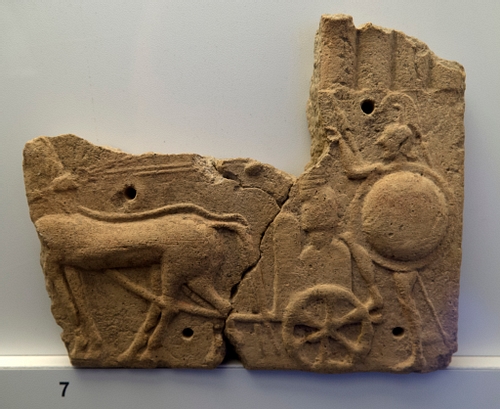 Revetment Plaque, Acquarossa Dan Diffendale (CC BY-NC-SA) ](https://www.worldhistory.org/image/6319/revetment-plaque-acquarossa/ "Revetment Plaque, Acquarossa")### Terracotta Roof Decorations
Small finds included many terracotta roof decorations typical of Etruscan architecture. They were made from local clay indicating that Acquarossa had its own workshops. Some of the terracottas are from the 'orientalising' period of [Etruscan art](https://www.worldhistory.org/Etruscan_Art/) and architecture. Dating to the latter part of the 7th century and early 6th century BCE, they were used to decorate the sloping roofs of Etruscan public and even modest private buildings and show an indigenous tradition independent of [Greek](https://www.worldhistory.org/disambiguation/greek/) [Archaic](https://www.worldhistory.org/disambiguation/Archaic/) architecture. Many are painted white on red with figures of horses, birds, fish, and in one example, a seated male. Some, although weather-worn, depict a pair of cut-out quadrupeds facing each other as in a heraldic emblem, and another type is shaped into griffins. Later types of terracotta decoration are more standardised and represent chains of interlocking ribbons, lotuses, or palmettes, all illustrating an increased influence from [Greece](https://www.worldhistory.org/greece/) and [Magna Graecia](https://www.worldhistory.org/Magna_Graecia/).
Painted terracotta relief plaques were once pinned to the gable ends of a building in the sacred complex. These were moulded to show scenes of a dinner or drinking party with guests lounging on benches; musicians and dancers, including one acrobatically doing a cartwheel; and a procession of warriors carrying spears and shields accompanied by charioteers. One [chariot](https://www.worldhistory.org/chariot/) is pulled by a winged horse, and depictions of [Hercules](https://www.worldhistory.org/hercules/) wrestling with the Nemean lion and the Cretan bull show a Greek influence. The majority of Etruscan artefacts from Acquarossa are now on display in the National Etruscan Museum at Viterbo.
#### Editorial Review
This human-authored definition has been reviewed by our editorial team before publication to ensure accuracy, reliability and adherence to academic standards in accordance with our [editorial policy](https://www.worldhistory.org/static/editorial-policy/).
## Bibliography
- [Hornblower, S:. *The Oxford Classical Dictionary.* Oxford University Press, 2012.](https://www.worldhistory.org/books/0199545561/)
- [Simon, E. *The Religion of the Etruscans.* University of Texas Press, 2006.](https://www.worldhistory.org/books/0292721463/)
- [Spivey, N.J. *Etruscan Art.* Thames & Hudson, 1997.](https://www.worldhistory.org/books/0500203040/)
## About the Author
Mark is WHE’s Publishing Director and has an MA in Political Philosophy (University of York). He is a full-time researcher, writer, historian and editor. Special interests include art, architecture and discovering the ideas that all civilizations share.
## Timeline
- **c. 700 BCE - c. 500 BCE**: [Etruscan](https://www.worldhistory.org/Etruscan_Civilization/) [Acquarossa](https://www.worldhistory.org/Acquarossa/) flourishes.
- **c. 500 BCE**: [Etruscan](https://www.worldhistory.org/Etruscan_Civilization/) [Acquarossa](https://www.worldhistory.org/Acquarossa/) is destroyed and definitively abandoned.
## Cite This Work
### APA
Cartwright, M. (2017, February 03). Acquarossa. *World History Encyclopedia*.
### Chicago
Cartwright, Mark. "Acquarossa." *World History Encyclopedia*, February 03, 2017. .
### MLA
Cartwright, Mark. "Acquarossa." *World History Encyclopedia*, 03 Feb 2017, .
## License & Copyright
Submitted by [Mark Cartwright](https://www.worldhistory.org/user/markzcartwright/ "User Page: Mark Cartwright"), published on 03 February 2017. The copyright holder has published this content under the following license: [Creative Commons Attribution-NonCommercial-ShareAlike](https://creativecommons.org/licenses/by-nc-sa/4.0/deed.en). This license lets others remix, tweak, and build upon this content non-commercially, as long as they credit the author and license their new creations under the identical terms. When republishing on the web a hyperlink back to the original content source URL must be included. Please note that content linked from this page may have different licensing terms.